


Children’s bedding is far more than just a pretty bedroom detail. It’s a direct investment in your child’s health, safety, and sleep quality. The right set can noticeably improve your little one’s rest and, of course, their overall mood.
Why should we pay special attention to children’s bedding?
When choosing bedding for a child, the most important thing to understand is that their needs are completely different from those of an adult. Children’s skin is much more sensitive and thinner, so regular, sometimes rougher fabrics can irritate it or cause discomfort. Also, let’s not forget that little ones’ bodies are still learning to regulate temperature, so they overheat or get cold much faster.
This is where quality children’s bedding comes in, designed with these unique needs in mind.
Comfort and a safe sleep environment
Soft and gentle fabric creates a calming and safe environment—it’s like a cozy, gentle embrace that accompanies your child all night long. This sense of comfort directly affects sleep quality, helping your little one relax and fall asleep faster.
What factors create the perfect sleep environment?
- Breathability: Natural fabrics, such as 100% cotton, allow the skin to breathe freely. This helps prevent overheating and sweating—two of the most common reasons why children wake up at night.
- Gentle on skin: Smooth, non-irritating fabrics like sateen are especially pleasant for sensitive skin. They don’t cause friction and keep your child comfortable all night long.
- Safe materials: Reliable manufacturers use certified fabrics and dyes free from harmful chemicals. This ensures the bedding is safe even for the smallest children.
Impact on sleep quality
Peaceful, uninterrupted sleep is vital for a child’s growth, development, and immune system. Well-chosen bedding becomes a powerful tool to help achieve this goal. In fact, even 1 in 4 children under the age of 5 experience sleep difficulties, such as frequent waking or trouble falling asleep. To address this, parents are increasingly seeking specialized bedding made from natural, breathable materials that help maintain stable body temperature. You can read more about improving children’s sleep in the Flokati.lt article.
Investing in quality children’s bedding is an investment in peaceful nights for both your child and yourself. By creating a safe and comfortable environment, we lay the foundation for healthy child development.
Comparison and selection of the most popular fabrics
Choosing fabric for children’s bedding is almost like picking your little one’s best sleep companion. After all, it will be by their side every night, so it needs to be soft, reliable, and perfectly suited to your child’s needs.
In this section, we’ll look at the two most popular types of cotton—cotton fabric and sateen. Although both come from the same plant, their properties are as different as night and day.
Cotton fabric: for durability and coziness
Cotton fabric is a true classic, easily compared to your favorite cotton T-shirt. It’s a fabric with a matte surface and a slightly noticeable but very pleasant texture.
The main weaving method—one thread above, one below—creates an incredibly strong and long-lasting structure. That’s why children’s bedding made from cotton fabric stands up well to frequent washing and active daily use.
Additionally, cotton fabric is highly breathable, making it ideal for warmer seasons or for children who tend to sweat more during sleep. It allows the skin to breathe freely and helps prevent overheating.
Cotton sateen: for softness and luxury
Cotton sateen is a completely different story. Imagine it as a luxurious, silky-soft blouse. Thanks to a special weave (one thread above, four below), sateen’s surface is incredibly smooth, soft, and has a subtle, barely noticeable sheen.
This fabric is denser than cotton fabric, so it naturally retains heat better, while in winter it pleasantly cools. Although sateen is also breathable, its main advantage is its indescribable softness, which is especially suitable for a child’s sensitive and delicate skin.
The softness of sateen not only gives a sense of luxury but is also very practical. Its smooth surface wrinkles less and attracts less hair or lint.
Cotton fabric vs. sateen: when to choose which?
To make your decision easier, we’ve prepared a quick comparison.
Comparison of children’s bedding fabrics
This table will help you quickly compare the main properties of cotton fabric and cotton sateen, making it easier to choose the best fabric for your child’s bedding.
| Feature | Cotton fabric | Cotton sateen |
|---|---|---|
| Feel | Firm, slightly rough, cozy | Soft, smooth, silky |
| Appearance | Matte surface | Subtle sheen |
| Warmth | Warm and cozy, thicker | Highly breathable, lighter, pleasantly cooling |
| Best season | Winter, autumn | Summer, spring |
| Durability | Extremely strong and resistant | Durable, but requires gentler care |
| Care | Easy to care for, washing-resistant, wrinkles more | Wrinkles less, recommended to wash at lower temperatures |
The most important thing to remember is that both of these fabrics are made from 100% cotton, so they are completely natural and gentle on your child’s skin. The final decision usually depends on personal needs and the feeling you’re looking for. If you want to dive deeper, check out our comprehensive guide on how to choose fabric for new bedding.
Other great alternatives
Although cotton is truly the queen of children’s bedding, it’s worth knowing about other excellent fabrics too.
- Bamboo: This fabric has natural antibacterial properties and is suitable for children with allergies. It’s incredibly soft, absorbs moisture well, and regulates temperature, making it suitable for any season.
- Linen: Linen bedding is a real lifesaver on hot summer nights. It’s exceptionally breathable and pleasantly cooling. Although linen tends to wrinkle, it gets softer with every wash.
In summary, cotton fabric is a great choice if you’re looking for a practical, durable, and breathable option. Plus, cotton fabric is easy to dye, so we can offer playful and vibrant children’s bedding sets. Meanwhile, sateen is perfect for those who value luxurious softness, warmth, and want to create an especially cozy sleep environment.
How to choose the ideal bedding size
Choosing the right size for children’s bedding is much more important than just an aesthetic issue. It directly affects your child’s safety and sleep comfort. A cover that’s too large can dangerously wrap around a small child, while one that’s too small will simply annoy them, as the duvet inside will constantly bunch up.
Just think about how you feel wearing shoes that are too big or too small—both are terribly uncomfortable. The same goes for bedding. The ideal size ensures the duvet lies flat inside the cover, doesn’t slip, and does its job—keeping your child warm and cozy.

Standard children’s bedding sizes
Although there are many options on the market, a few popular standards have become established, tailored to children of different ages and various beds.
- For cradles and strollers: The smallest sets reign here, such as 80x100 cm or 90x120 cm. These are designed for newborns and ensure during the first months that your baby won’t get tangled in excess fabric.
- For standard baby cribs: The most popular and universal choice is a 100x135 cm duvet cover and a 40x60 cm pillowcase. This size fits standard 60x120 cm cribs perfectly and usually serves a child up to 3–4 years old.
- For older children’s beds: When your child moves to a larger, “grown-up” style bed (for example, 90x200 cm), they’ll need larger bedding. In this case, most often you’ll switch to a 140x200 cm size set.
How to measure correctly and avoid mistakes
If you want to avoid disappointment when unpacking your new purchase, the best way is to take precise measurements. Before buying a new bedding set, take a few minutes for this:
- Measure the duvet and pillow: Take a tape measure and check the length and width of your existing duvet and pillow. These are the most important numbers.
- Check the label: If you have an old but perfectly fitting cover, look at its label—the listed dimensions can be a great reference.
- Measure the bed only for the fitted sheet: If you’re buying a fitted sheet, it’s important to know not only the mattress length and width but also its height. This way, you’ll be sure the sheet will fit snugly and won’t slip.
The most common mistake is guessing “by eye” or buying without checking what sizes you already have at home. Remember, different manufacturers’ standards can vary slightly. If you want to dive deeper into this topic, check out our guide on how to choose the right bedding cover size.
When is it safe to give a child a pillow?
This question comes up for almost every parent. Experts unanimously agree: for babies under 1 year old, a pillow is not only not recommended but also dangerous due to the increased risk of sudden infant death syndrome (SIDS).
The best time to start using a pillow is when your child moves from a crib to a larger bed, usually from 2–3 years old. The first pillow should be:
- Thin and low: Its purpose is just to slightly lift the head so the spine stays in a straight line.
- Firm: The child shouldn’t “sink” into the pillow; it should provide stable support.
- Properly sized: The standard 40x60 cm size is optimal and perfectly suited to a child’s proportions.
Choosing the right bedding size is a small but incredibly important step. This creates a safe and comfortable sleep environment that will help your child rest well and grow up healthy.
Safety and allergies: what every parent must know
When it comes to children’s sleep, parents’ peace of mind is the most important thing. And we can only be calm when we know our little one is sleeping safely. In the world of children, safety requirements are much stricter than for us adults, so it’s important to consider everything when creating a cozy sleep environment. The right children’s bedding is one of the key elements of peaceful sleep.
Pediatricians constantly emphasize one golden rule—minimalism in the baby’s crib. What does this mean in practice? There should never be any unnecessary items: no soft toys, no loose blankets, no large, fluffy pillows. Each of these extras, unfortunately, can become a hazard.
When to “allow” a duvet and pillow in your child’s bed?
One of the most common questions that worries parents is when it’s safe to use a pillow and duvet. While you may want to create a cozy, soft nest as soon as possible, there’s no need to rush.
Expert recommendations on this are very clear and consistent:
- Pillow: For babies under one year, a pillow is not only unnecessary but also dangerous. It can increase the risk of sudden infant death syndrome (SIDS). It’s safe to start using one only at 2-3 years old, when your child moves to a bigger bed. Even then, the first pillow should be very thin, quite firm, and suited to a child’s small frame.
- Duvet: It’s safe to cover your child with a duvet from about 12 months old. Until then, a sleeping bag is a much safer and more comfortable choice.
Sleeping bag—why is it a better alternative?
Think of a sleeping bag as a wearable duvet. Its biggest advantage is that it can’t be kicked off, won’t cover the face, and won’t wrap around the body. A sleeping bag ensures your baby stays warm and safe all night long.
Additionally, many parents notice that sleeping bags soothe little ones by creating a safe, cozy feeling, somewhat reminiscent of being in the womb. For parents, it’s a real lifesaver, allowing for more restful nights.
How to avoid allergies? Focus on hypoallergenic fabrics
Children’s skin is especially sensitive and thin, so allergy prevention is another important task when choosing bedding. The most common “culprits” causing problems are dust mites, mold, and of course, chemicals used in fabric production.
To avoid unpleasant reactions, such as skin rashes or respiratory irritation, it’s essential to choose the right materials. Synthetic fabrics like polyester don’t allow the skin to breathe. As a result, children sweat more, and the warm, damp environment is perfect for bacteria to multiply.
The best solution for sensitive skin is natural, breathable fabrics. They help maintain normal body temperature and reduce the risk of any irritation.
When looking for hypoallergenic solutions, pay attention to products specifically designed for this purpose. For example, you can find a hypoallergenic duvet and pillow set with filling tailored for sensitive children.
What does the OEKO-TEX® label mean?
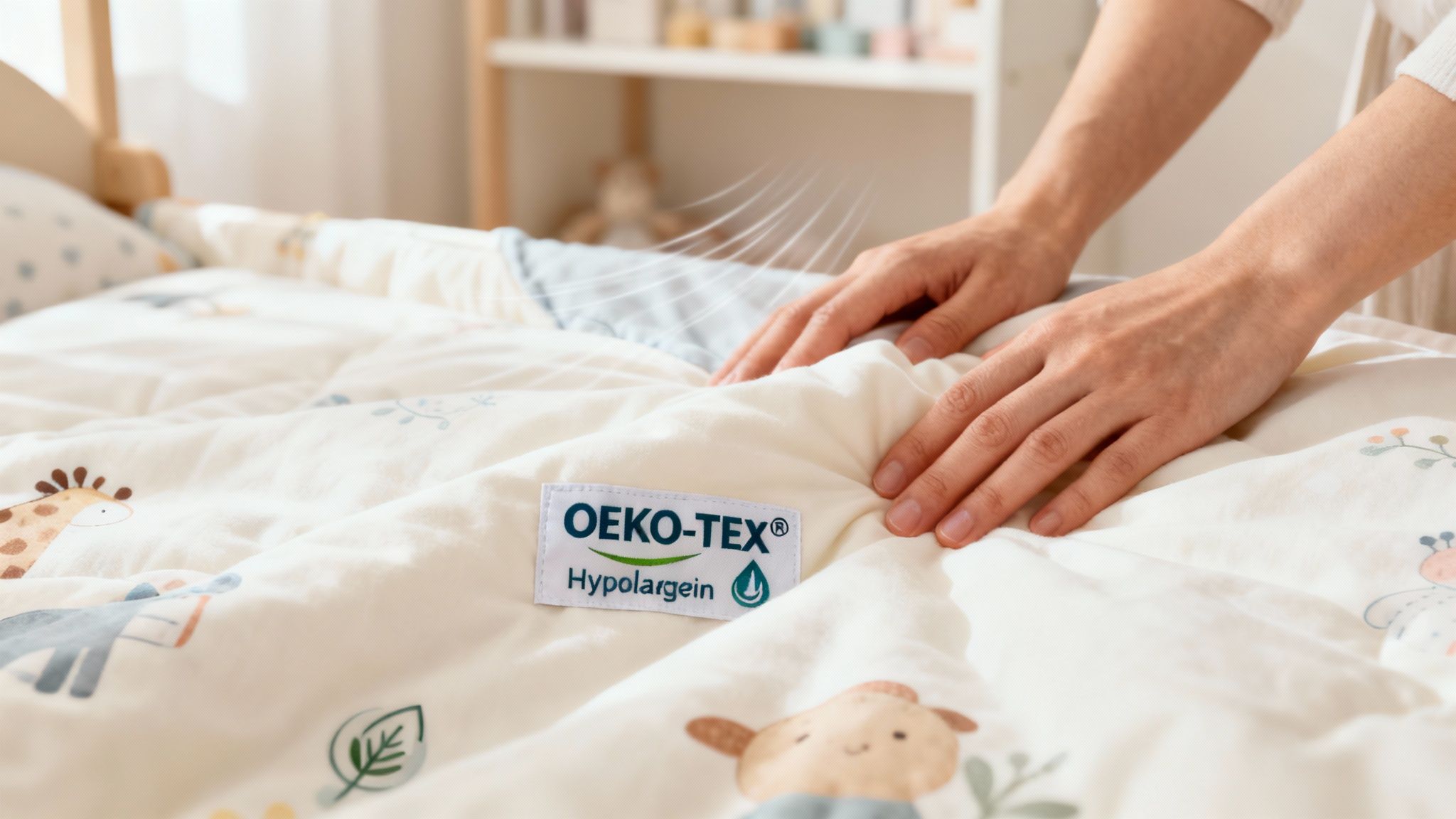
When choosing bedding, always look for the OEKO-TEX® Standard 100 label on the tag. This is a globally recognized standard that guarantees the product has been thoroughly tested and contains no harmful chemicals.
This certificate means every part of the fabric is completely safe and won’t irritate sensitive children’s skin. It’s a promise of quality and safety you can trust.
In short, creating a safe sleep environment consists of a few simple but essential steps:
- Only the essentials in the crib: No toys, no unnecessary pillows.
- Everything in its own time: Don’t rush with the duvet and pillow—wait until your child is older.
- Sleeping bag for little ones: Choose a safe and comfortable alternative for babies.
- Prioritize natural materials: The best friends are 100% cotton, bamboo, or linen.
- Look for certifications: Make sure the bedding has the OEKO-TEX® label.
By following these guidelines, you’ll create not only a beautiful and cozy but also a maximally safe sleep kingdom where your child can rest peacefully and healthily.
Long-term care and washing of children’s bedding
When you buy quality children’s bedding, you want it to last as long as possible and stay beautiful. Proper care not only extends its life but also ensures your child’s sleep environment is hygienic and healthy. Fortunately, it’s quite simple—just follow a few golden rules.
Well-cared-for bedding pays off—it retains its color, softness, and most importantly, helps you care for your child’s health.
Washing temperature and detergents
The first step before washing is always to check the manufacturer’s label. That’s the most reliable source. However, there are a few universal rules that apply to most cotton bedding sets.
To destroy dust mites and bacteria, it’s ideal to wash at 60 °C. However, if the bedding is brightly colored or patterned, a safer choice is 40 °C. This temperature is still effective but helps preserve vibrant colors longer.
What about detergents? For sensitive children’s skin, choose carefully:
- Hypoallergenic detergents: Look for those without fragrances, dyes, or other strong chemicals. The simpler the formula, the better.
- Eco-friendly products: These are usually gentler on both skin and the environment.
- Liquid detergents: They rinse out of fabric fibers more easily and quickly than powders, so there’s less risk of irritating the skin.
Important tip: try to avoid fabric softeners. While they add a pleasant scent, their chemical composition can build up in the fabric, reduce breathability, and irritate sensitive skin.
How to deal with stains
Stains are an everyday occurrence in a child’s world. The most important rule is to act quickly and avoid aggressive chemical cleaners that can harm both the fabric and your child’s skin.
Here are a few tried-and-true ways to tackle common stains:
- Juice or fruit: Immediately rinse the fabric under cold running water. If the stain remains, gently rub it with bile soap before washing.
- Milk or food residue: Soak the item in cold water (hot water will “lock in” the proteins and make the stain much harder to remove), then wash as usual.
- Markers: Try dabbing the stain with alcohol or milk, let it sit for a bit, then wash. Always test the cleaner on a less visible area of the fabric first.
How often to change bedding
The freshness of your child’s sleep environment depends on how often you change the bedding. Children sweat during sleep, and bedding accumulates dead skin cells, which are perfect food for dust mites.
Experts recommend changing children’s bedding once a week. If your child is sick, sweats more, or has allergies, change it even more often—about every 3–4 days. This simple habit will ensure your child’s sleep is always fresh, hygienic, and safe.
When standard solutions don’t fit: custom orders
Sometimes, standard size charts and store shelves just don’t meet your needs. Maybe you have an old, non-standard size crib at home, or maybe you want to create something truly unique—matching your room’s interior and reflecting your child’s personality. That’s when the beauty of custom orders comes to life.
This isn’t just buying bedding. It’s a creative process where you become the designer. You can choose not only the perfect dimensions but also the fabric type—cozy and practical cotton fabric or soft and more luxurious-looking sateen. You can also mix and match colors and patterns, creating a dream set that no one else will have.
The benefits of local production
By choosing custom sewing from local manufacturers like “Rustilė”, you get much more than just a product. You get personal attention, flexibility, and most importantly, reliable quality. Local artisans can advise you, help you choose the best fabric, and bring even the smallest details of your vision to life.
Plus, it’s a great way to support Lithuanian business. Every such order helps create jobs and strengthen our country’s economy. Local production usually means higher quality control, as each product passes through caring hands, not a mass production line.
A custom order is a chance to turn a standard purchase into a personal story. It’s bedding made especially for your child, with your thoughts and love.
The growing popularity of custom orders shows a clear trend—parents value quality and uniqueness more and more. For example, some Lithuanian manufacturers produce thousands of custom children’s bedding sets each year because parents want not only practical but also unique items. The increasing focus on eco-friendly materials and personalized solutions shows a mature approach to children’s well-being.
Services that create a pleasant experience
Reliable manufacturers understand that the shopping experience doesn’t end when you add an item to your cart. They offer additional services that make the whole process even more enjoyable:
- Fast delivery: When you want to delight your little one sooner, it’s important that your order arrives on time.
- Gift cards: A great idea if you want to give a practical and original gift but let the parents choose the design themselves.
- Festive packaging: Sometimes the little things bring the most joy. A beautifully wrapped gift always leaves a special impression.
- Long-term guarantees: Things like a 30-night trial guarantee and a 365-night seam guarantee clearly show the manufacturer’s confidence in their product’s quality and durability.
By choosing custom sewing, you’re investing not only in a quality item but also in a unique experience and peace of mind, knowing your child’s sleep is wrapped in genuine care.
Frequently asked questions
When choosing bedding for your little one, you’re bound to have questions. And that’s natural—you want only the best for your child. To make your decision easier, we’ve gathered the most common dilemmas parents face and answered them briefly and clearly. We hope this helps you feel more at ease and confident.
From what age is it safe for a baby to use a pillow?
This is one of those questions where safety is the absolute priority. Pediatricians unanimously agree—for babies under one year, a pillow is not only unnecessary but can also be dangerous.
It’s safe to introduce the first pillow into your child’s bed at around 2–3 years old, when they move to a bigger bed. Most importantly, the first pillow should be very thin and firm enough—its purpose is to gently support proper spinal alignment, not to let the head sink into softness.
What is the best washing temperature?
To ensure maximum hygiene and get rid of dust mites or bacteria, 100% cotton bedding is best washed at 60 °C.
However, if you’ve chosen brightly colored or patterned bedding and want to preserve its beauty as long as possible, a safer choice is 40 °C. This temperature also effectively removes dirt but is much gentler on fabric colors.
Always remember the golden rule—check the manufacturer’s recommendations on the label first. That’s the most reliable source for how to properly care for a specific product.
How often should children’s bedding be changed?
To keep the sleep environment clean and healthy, it’s recommended to change children’s bedding once a week. This is the optimal frequency under standard conditions.
If your child gets sick, sweats more at night, or has allergies, change the bedding more often—about every 3–4 days.
Is a sleeping bag better than a duvet?
For babies under one year, a sleeping bag is a much safer alternative. Unlike a duvet, it can’t accidentally cover the face during sleep and prevents your little one from kicking it off, so they stay warm and cozy all night.
A sleeping bag creates a pleasant sense of security, reminiscent of being in the womb, so it helps babies sleep more peacefully. It’s safe to start using a duvet from about 12 months old.
We hope these answers have cleared up your doubts. If you’re looking for quality, safe, and custom-made bedding, we invite you to browse the Rustilė online store. Here you’ll find a wide range of 100% cotton products and can create the sweetest sleep kingdom for your child https://rustile.lt.
Leave a comment